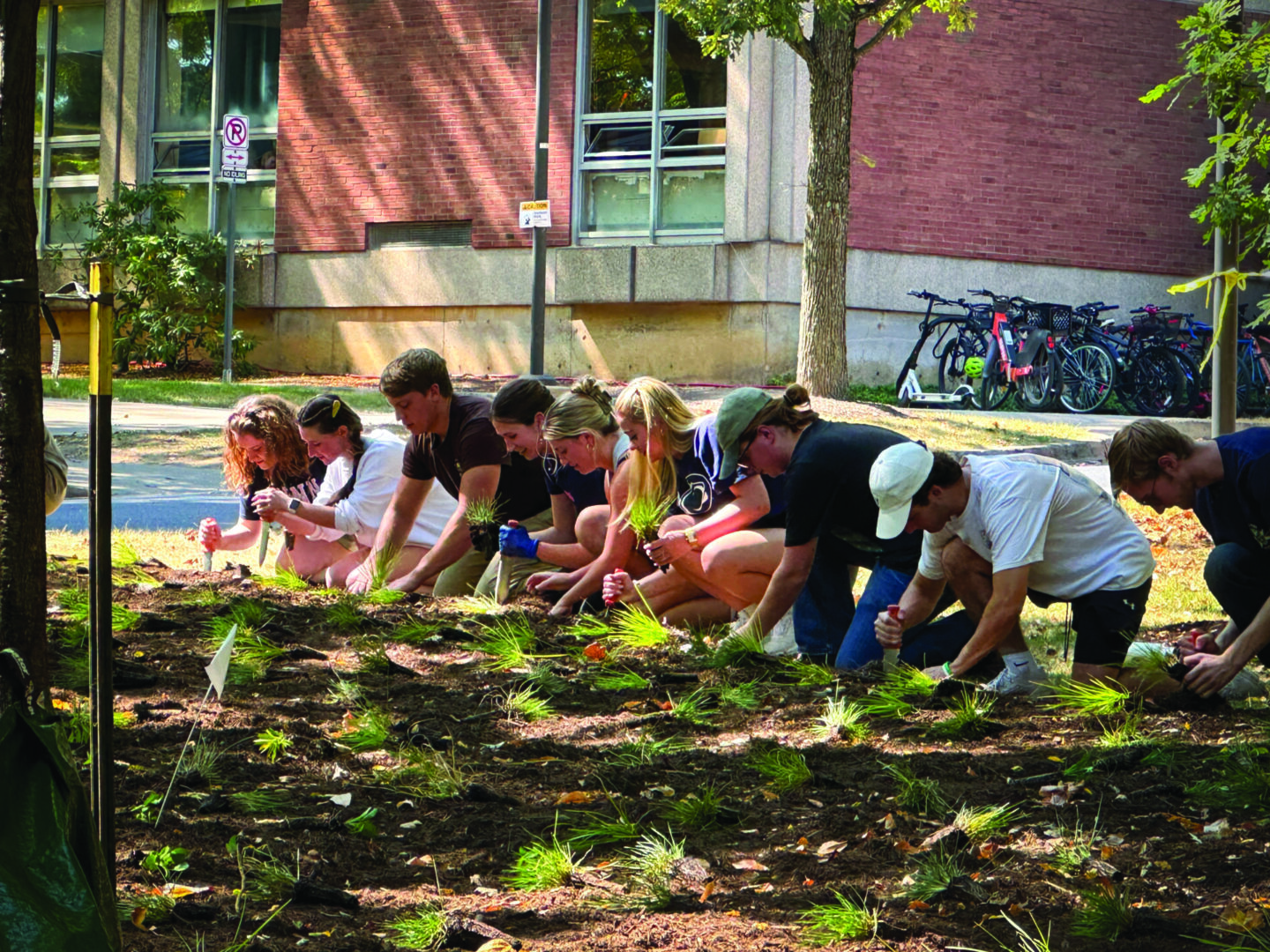
How campus stewards are building a more sustainable University Park
To bid farewell to seemingly endless winters, University Park displays an array of color and fragrance along the walkways, buildings, groves, and meadows throughout the grounds. Photographers, writers, botanists, and the community can find moments of joy in the fresh blooms seen as the season of spring unfolds.
In May 1966, during the inaugural year of Town&Gown, an article titled “In Focus … Spring on Campus” appeared. The seven-paragraph piece describes how gardens and plantings across Penn State’s campus anticipate the season ahead. In the opening, the writer describes “yellow Winter Jasmine blossoms which appear along the front of Sparks Building while March winds are still chilly.”
Continuing, the piece explains how “The Shadbush or Serviceberry waits until late spring to display its white blooms,” the way “Bright yellow forsythia cascades through many areas of the campus,” and how “The Flowering Cherry trees splashed about the campus (to) blossom in late April.” Other notable mentions include crabapple, pink and white dogwood, tulips, daffodils, and spirea.
Despite the Town&Gown depiction of blossoming species, the gardens that are seen today hadn’t arrived. Instead, grass covered much of University Park.
During that era, according to Manager of Ground Services Thomas Flynn, lawns figured prominently in plantings on campus. The Old Main and Hub lawns remain, although others have undergone changes.
“We’re undoing and retooling some of the mistakes made during that time,” he says, “and small garden spaces are ever evolving.”
The campus’ iconic groves, rows, and individual plantings of a variety of trees continue to thrive under the care of groundskeepers, arborists, and many other agencies. These include the Office of the Physical Plant, landscape crews, the Agriculture Department, Flynn’s department, and others dedicated to nurturing the elms, spruces, tulip trees, and many more.
“Trees tie everything together,” Flynn says.
Hort Woods, a significant project, covers four acres along Park Avenue near North Halls. With a goal of sustainability, the space consists of native plantings with mature trees filling in the canopy.
“We removed many invasive species from the area,” says Derek Kalp, Senior Landscape Architect, “and replaced them with native varieties to improve diversity and ultimately, reduce costs.”
Continuing, Kalp explains, “Biodiversity in a native habitat is more sustainable. Many natives are drought resistant, and that also reduces costs.”
Campus landscaping approaches have moved away from small plantings with attractive annuals, like petunias and geraniums, to lower-maintenance perennials. And the reduction of grassy areas means less mowing, which means lower costs for grounds crews.
“One-third of the campus is turf,” he continues, “which has to be mowed every five to seven days. One of the goals is to select 85 acres to convert into low landscapes with shrubs and ground covers to reduce fussy lawn patches. Tiny lawn patches don’t make sense.”
Traditional plantings will slowly move into the more sustainable approach that Kalp and his colleagues envision.
“Annuals displays will still continue in places like the container plantings at the Allen Street Gate,” he says, “but the horticulture techs are moving into a more intense use of perennials.”
Visitors now, Kalp says, will notice more things like native butterfly weed, barren strawberry, and asters, with tufted hair grass and sedges.
Flynn notes that, throughout the seasons, certain plantings may fade.
“My staff will take on successional plantings as spring, summer, and fall move along,” he says.
Moving on, Kalp discusses the Chapel Woods area, another space of biodiversity located between the Pasquerila Spiritual Center, Eisenhower Chapel, the Forum Building, and Curtin Road. Financed in part by an endowment covering half the cost, the area creates a wooded spot for visitors and students to enjoy yet another project of sustainability.
“We’re converting Chapel Woods into a shade meadow,” he says, “with taller, sun-loving plants providing shade for lower-growing varieties.”
Just a stone’s throw from the Forum Building, Chapel Woods, like many other green spaces on campus, helps soften the transition between cement roads and steel buildings, as Flynn mentions.
“In these places you find architecture and landscape intertwined,” he says. “And some of the buildings are from the 1920s and 1930s. The interstitial spaces between buildings established a frame for the mods, quads, and courtyards, and are some of the most iconic spaces we have.”
Penn State’s OPP has criteria by which a tree can become a designated ‘Heritage Tree.’ This policy provides a framework for some of University Park’s trees to be identified, acknowledged, and protected as irreplaceable trees on the campus. These trees must meet requirements for age. If used as a criterion for designation a tree must have reached the age of 100 years. Other criteria include historical significance, a tree’s location, and its’ size. OPP lists all Heritage Trees and the designation particulars on their website, f1oap-gis04.ad.psu.edu/trees/heritage/HeritagePolicy.asp.
“We have trees from the 1800s that are valued and treasured,” Flynn states.
One of the most striking developments in campus floral offerings, trees, shrubs, and other greenery spans about 370 acres along Park Avenue. The Arboretum at Penn State attracts 250,000 visitors per year, according to Casey Sclar, director of the Arboretum.
“We’re extremely proud of it,” Sclar states.
He mentions the Hosler Oak, the witness tree of the Arboretum. Planted in 2005, the white oak honors former Penn State Dean Charles Hosler. The first tree planted on the site, it overlooks the H.O. Smith Botanical Garden.
“It was a funding campaign gift from Skip Smith [Penn State alumnus and philantropist],” he continues, “He was the son of H.O. Smith, who also supported Penn State.”
He wants people to know that the Arboretum extends from Park Avenue all the way to the bypass, and beyond the rail trail.
The area encourages strolling, he says.
“A lot of students rely on it to get away from the urban island,” he observes, “They can come here and relax and feel welcomed by nature. Also, they can volunteer and be part of experiential learning, which leads to greater success.”
The Arboretum includes specialty areas. The H.O. Smith Botanical Gardens include 10 acres of thematic gardens, and give way to low hills, meadows, and walking areas. The Pollinator and Bird Garden, the Children’s Gate Garden, the Rose Garden Bower, the Rose and Fragrance Garden, and many others incorporate walkways, waterscapes, sculptures, and signage, all designed for pleasure and learning.
“Spring is only one of the seasons to appreciate the highlights,” Sclar adds, “It has stunning appeal in spring, but also throughout the seasons.”
Could the writer and the readers of the Town&Gown piece from 1966 have imagined that the tulips, forsythia, and spirea would have represented a small portion of the projects we see unfolding now?
The article concludes with the words, “It would seem the old battle cry of ‘Keep America Green’ is certainly applicable to Penn State’s campus.”
Flynn, Sclar, and Kalp, along with the hundreds of volunteers, workers, landscape architects, maintenance crews, arborists, horticulturists, designers, staff, preservationists, landscapers, and researchers have dedicated their careers to working toward the goal of sustainability. Others who pitch in include the College of Agriculture and the Palmer Museum.
“Finally, I just wanted to further emphasize that I am humbly speaking for our much larger OPP landscape team,” Kalp stresses, “Our three landscape architects and project coordinator work closely with our grounds manager, three supervisors, six group leaders, and 80-plus technicians. Springtime is our biggest ally, and we planners and designers help steer the ship, but it’s our supervisors and technicians who have the expertise to get the job done, no matter the conditions!”
“It’s not just the work of a few,” Flynn adds, “So many people work so hard.”
“Penn State is certainly living out its land grant mission,” Sclar says.
Continuing, he comments about the future of the gardens and grounds of University Park.
“I hope that 60 years from now we will see the fruits of our labors continue with the wonderful things we see today, with more plants supporting conservation and an eco-sensitive approach,” he concludes. Nature decides what can be there, and living in harmony with nature brings out our best aspects.” T&G
Anne Dyer Walker is a Bellefonte freelance writer.